3/30/2026
When the Finish Line Gets Closer, the Pressure Gets Louder
Reaching a project's first milestone tests leadership under pressure, requiring clarity to balance uncertainty and speed. Success comes from committing with enough information and adjusting as progress unfolds.
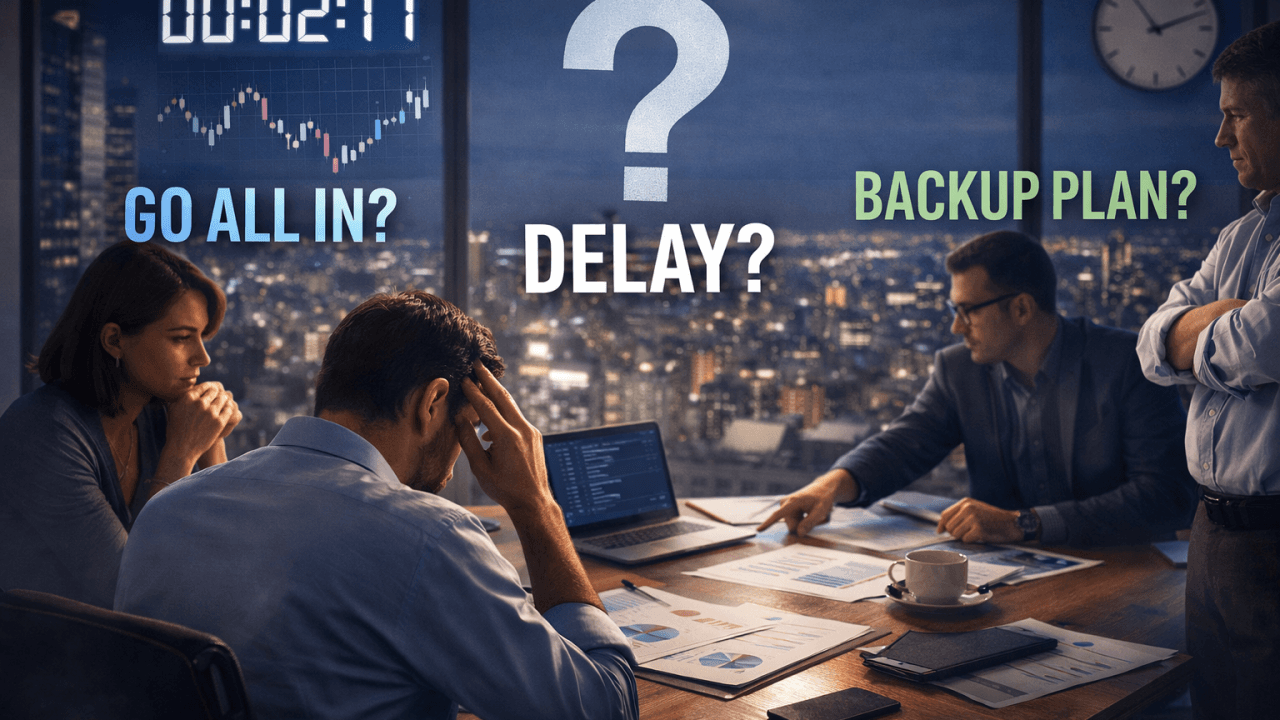
The Last Mile
After weeks of work, all hands on deck, we were finally approaching the finish line.
A major milestone. The first of its kind for the project.
Nothing, on the surface, suggested we couldn't make it.
The team was pushing. Progress was visible. Momentum was there.
But this was the first milestone.
And with it came something else.
Uncertainty.
Because in today's environment, the first milestone is rarely complete. It carries assumptions. It carries downstream unknowns. It's built on movement, not perfection.
And as we got closer, the pressure got louder.
More eyes were on it. More questions started coming in.
"Are we ready?"
"What are the risks?"
"Do we really know this will work?"
And then the conversation shifted.
Not about the work itself.
But about the decision.
Three options started to surface:
- Do we go all in and push through?
- Do we keep the old way running in parallel?
- Or do we delay slightly to ensure quality?
You could feel it.
The leadership team wasn't just evaluating progress anymore.
They were revealing how they handle uncertainty.
The Nature of Work Today
This isn't unusual anymore.
Most initiatives today aren't built on perfect clarity.
They're driven by:
- Market demand
- Competitive pressure
- The need to move fast
- The expectation to adapt as we go
Which means the first milestone carries the most weight.
It sets direction. It builds confidence. And it exposes uncertainty at the same time.
The Three Options and What They Really Mean
1. Go All In
What it is: Commit fully. Push forward. Hit the milestone.
What it means: We accept uncertainty and move anyway.
What it feels like: This is what the team has been doing. It builds momentum. But it requires confidence in an incomplete picture.
2. Run a Parallel Track
What it is: Keep the old way running as a backup.
What it means: We are hedging against failure.
What it feels like: It sounds responsible. But it splits focus. And signals we're not fully committed.
3. Delay for Quality
What it is: Push the milestone out slightly.
What it means: We prioritize certainty over speed.
What it feels like: It feels safe. But without a clear signal we can't meet the milestone — it raises the question: Are we solving a real issue, or reacting to pressure?
What's Actually Being Tested
This isn't just a delivery decision.
It's a leadership moment.
Because what's being tested is:
- How you handle uncertainty
- How you interpret pressure
- How you balance speed and clarity
- And most importantly, how you decide when you don't have perfect information
What I Observed
The pressure wasn't coming from the work itself.
It was coming from the attention around the work.
More visibility → more questions
More questions → more doubt
More doubt → more pressure
And that pressure starts shaping decisions.
Not based on facts.
But based on perception.
Key takeaway: Pressure often emerges from increased attention and perception, not just the work. This shifts decisions away from facts toward emotion.
The Trap Many Leaders Fall Into
When pressure builds, leaders tend to react.
- Overcommit to prove confidence
- Overprotect to reduce risk
- Overdelay to buy time
But these aren't clarity-driven decisions.
They're pressure-driven reactions.
What Clarity Looks Like in This Moment
Clarity doesn't remove uncertainty.
It frames it.
It sounds like:
- What do we know for certain?
- What risks are real vs assumed?
- What is the cost of each option?
- What signal would tell us we need to change course?
Clarity creates structure.
And structure creates confidence.
The Shift That Matters
In that moment, I realized something simple.
The question isn't: "Which option feels safest?"
The question is: "Which option are we clear enough to commit to, and adjust from if needed?"
Because in fast-moving environments:
You don't wait for certainty. You move with clarity.
Try this:
- Focus on clarity over safety in high-pressure decisions.
- Commit with enough information and adjust as you progress.
- Frame uncertainty rather than trying to eliminate it.
Final Reflection
As teams watch leadership make these decisions, they're not just looking for direction.
They're looking for signal.
Do we trust our path?
Do we hesitate under pressure?
Do we react or lead?
The last mile of any project isn't just about delivery.
It's about leadership under pressure.
Because the closer you get to the finish line, the louder the noise becomes.
And clarity is what keeps you moving forward.